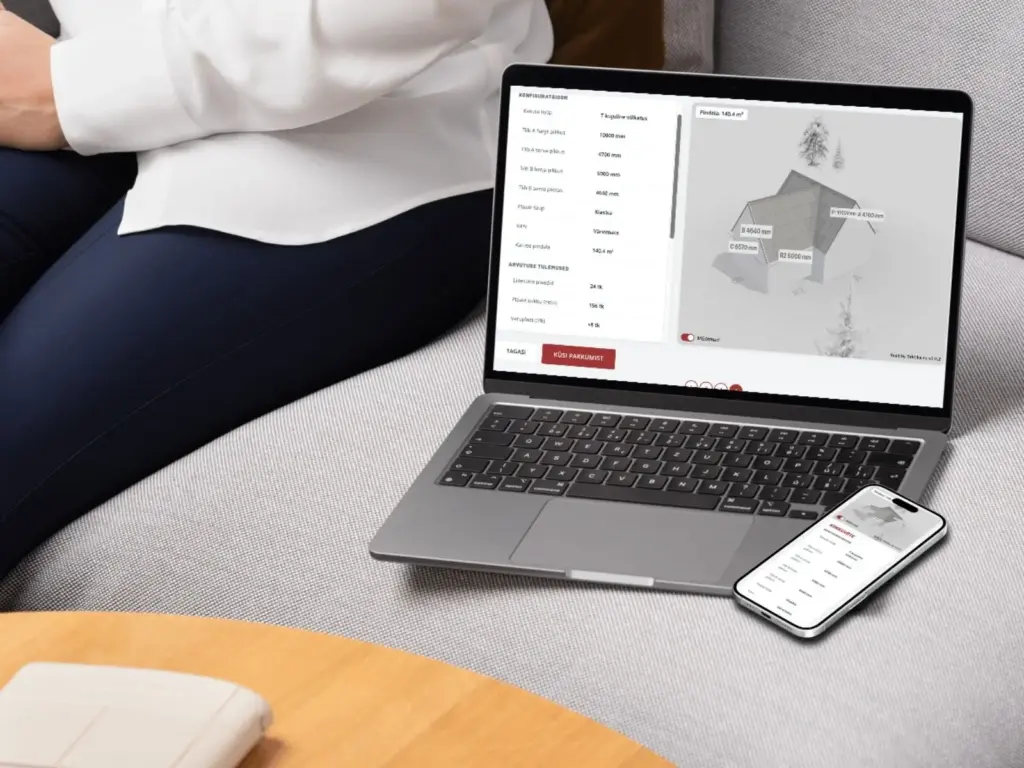
A Friday afternoon call to an AS Bestor Grupp sales consultant: a client has a 14×9 metre summer house with a hip roof on Hiiumaa and wants Eternit Klasika sheets, six diagonals in total. In the old model this kicks off an hour-long session. With no drawings, the consultant copies the information onto paper, opens Excel, looks up the Hiiumaa row in the transport price list, calculates the number of pallets, fills in the quote document template, sets the price, signs and sends. Half an hour at a minimum, and even more for L- and T-shaped roofs. By that time another client has already called in with their own wishes. As of 2 April 2026, the same quote takes five minutes on the same consultant’s desk. The client enters the roof dimensions on the bestor.ee/laineplaadi-katusekalkulaator page, chooses the sheet type, colour and accessories, sees the whole specification — number of sheets, accessory quantities, weight, pallets — and submits the inquiry through the form. Consultant Margus opens the ready specification, sets the price that suits the client, signs and sends. One consultant today handles essentially the entire Estonian corrugated-sheet quote flow, which under the old model would have required a second and, in high season, a third consultant. In the first 30 days, from a single channel alone, 72 quotes came in and went out — exactly twice as many as in the same calendar window the previous year (36 quotes in April 2025, the old form) and 47% more than just before the launch (49 quotes in March 2026, the same old form). The same Google Ads budget, the same brand, the same web address — only the calculation and specification surface is new. This article describes how the configurator works from both the client’s and the consultant’s perspective, what we deliberately did not build (and why that matters in wholesale), and what wholesalers considering the same step should take into account.
What a product configurator is in wholesale, and why Bestor needed one
A product configurator is a web tool that lets a client assemble an order specification matching their needs and immediately get a correct quote for it. In construction and project sales, a configurator replaces the long manual-preparation cycle that otherwise always travels the same path: inquiry → clarifying measurements → sketch → calculation → quote → revision round. In wholesale, however, there is one important difference compared with end-consumer web shops. A wholesaler’s pricing is separate for each client — it depends on the reseller’s price tier, on negotiated agreements and on a long-term client relationship. The same sheet type goes to different client groups at different prices, and a public price list would break the logic of the entire reseller chain. A classic web-shop configurator that displays a price on the page does not fit. For Bestor Grupp this was solved simply: the configurator shows the client the whole specification — number of sheets, accessories, total weight, number of pallets, transport weight class — but not the price. The client fills in a contact form, the sales consultant sees the ready specification, sets the price that suits the client and sends the quote out. The client gets an answer on average within a few hours — filled in, signed, with a targeted price. This is not a “broken configurator with the price missing”. It is a version of the configurator designed for the wholesale business model.
Bestor’s starting point: old form, same traffic, four times the time
The previous system was a basic form at the same web address: it asked for a name, contact and an approximate roof description. The form reached the consultant as text; the consultant read it, called back to clarify, drew the roof on paper, calculated the material consumption, looked up the correct row in the Bestor Grupp transport price list (17 counties × 5 weight classes), copied everything into the quote document template, set the price and sent. Typically 30 minutes for a simple gable roof, considerably more for L- and T-shaped roofs or hip roofs. The problem was not the number of visitors. April 2025 (old form): 36 quotes in 29 days. March 2026 (old form): 49 quotes in 29 days. The same brand, the same Google Ads budget (~€90 a day), the same form. Inquiries came in steadily — the question was whether the consultant could get through them all. Inquiry quality varied. Sometimes only the square metres came from the client — which was not enough to calculate accessories, because the sheet layout depends on the specific geometry. Sometimes a rough measurement arrived in a PDF file whose scale had to be double-checked. Sometimes a locked DWG file the consultant could not open. Every third to fourth inquiry needed at least one clarifying call before any calculation could even begin. Every quote also carried the risk of human error. Six different roof types, five sheet types, nine colours, six accessories, transport calculation: the maths is not hard, but it is dense and repetitive. For the same house two consultants might arrive at slightly different results — not by large margins, but enough that the question “what price did you give me last time” did not always have a certain answer. The decisive question was the same one typically asked by all companies with a growing inquiry flow. Do we hire a second consultant who mostly does calculations, or do we remove the calculation from manual work entirely? The maths of an annual salary versus a one-off development investment fell to one side.
In the old model, preparing a single corrugated-sheet quote took a Bestor sales consultant 30 minutes, more on complex L- and T-roofs. The configurator brought that down to 5 minutes.
What the client sees (and what they deliberately do not)
From the client’s point of view the process is five steps and takes on average 2–3 minutes up to submitting the inquiry:
- Roof type. Six options: ordinary gable roof, L-shaped gable roof, T-shaped gable roof, hip roof, L-shaped hip roof, T-shaped hip roof. Each type opens a different set of inputs — a gable roof has eaves + gable, the L-type four eaves edges and two gables, the hip roof eaves + ridge + hip length.
- Dimensions. Sliders for the dimensions of the roof’s main sections. The 3D model on the right updates with every change — the client sees their roof, rotatable and zoomable, with labels showing the main dimensions.
- Sheet type and colour. Eternit Gotika, Klasika, Villa, Agro or Agro XL × 9 colour options (unpainted, black, graphite, brown, dark red, cherry red, brick red, green, anthracite). Each choice is shown immediately on the 3D model with the corrugated texture, so the client sees the future roof — not an abstract colour swatch.
- Accessories. Ridge tile, end tile, edge cover, gable cover, valley flashing, bird stop and so on. The system calculates the required quantities automatically from the geometry: the ridge tile quantity for a gable roof comes from the ridge length, the valley flashing for L- and T-roofs comes from the valley diagonal, the bird stop comes from the total eaves length. The client does not need to know the accessory formula.
- Specification and inquiry form. The summary shows the total number of sheets, accessories, total weight, number of pallets, and the transport weight class according to the chosen destination county. The “Request a quote” form asks for a name and contact. The price is not displayed — that is the consultant’s decision for each client separately.
The deliberate choice not to show the price is the central architectural decision of this case. It is not a technical shortcoming — it is the wholesale business model codified into the user interface.
How the consultant’s desk changed
The consultant-side view before and after, step by step:
| Stage | Before (old form) | After (configurator) |
|---|---|---|
| Receiving the inquiry | Text, often incomplete | Structured specification: roof type, dimensions, all quantities |
| Clarifying measurements with the client | 5–15 min, depended on the inquiry | 0 min — the measurements are in the specification |
| Material calculation | 10–15 min by hand | 0 min — the configurator has already done it |
| Looking up the transport weight class | 2–3 min from the price list | 0 min — the weight class is in the specification |
| Setting the price | 5 min, per client | 5 min, per client (the same) |
| Filling in the quote document | 8–10 min of retyping | 1–2 min from the configurator specification |
| Signing and sending | 2 min | 1 min |
| Total | ~30 min | ~5 min |
The pricing point was left untouched. The price is set by a human, not an algorithm — and not because of a technical limitation, but because the wholesale business depends on the consultants’ pricing decisions. The configurator owns the calculation; the consultant owns the price. This boundary makes the step internally acceptable: the sales team does not lose decision-making power, it only loses the transfer of the calculation.
Margus, Bestor sales consultant: “The old way, preparing a quote for an L-shaped roof took about an hour — first I’d call the client about measurements, then make a drawing, calculate the sheets and look up the transport price in the price list. With the configurator I open the inquiry and the quantities are already set. My job is to set the price and sign — just as easy as for a simple gable roof.”
Technical decisions invisible to the client
The configurator is architecturally the same one we use in the Nordhauser Eternit configurator — the same engine, the same product catalogue, the same 3D render across two different client sites. In the Bestor version the integrations are adapted for wholesale: the Merit Aktiva sync is left out (Bestor does not use it), automatic reminders are left out (handled on the CRM side), automatic PDF generation is left out (the PDFs are generated by Bestor’s accounting software Eeva once the consultant sets and confirms the quote price). All six roof types, all five sheet types, all nine colours are the same. The four technical decisions that most affect the end result: The geometry of six roof shapes behind a single user interface. A simple gable roof is 2 rectangles. An L- and T-shaped hip roof is four trapezoidal surfaces that share the ridge, valley flashing and hip diagonals at a common apex point. Each roof type calculates sheets separately: full rows + edge cuts + ridge cuts + corner pieces, with offcuts reused where possible in the next zone. The user sees one 3D model; the system manages six branch structures. The configurator does not let the user enter combinations that cannot actually be built — this prevents the situation where a quote goes out for a house that does not exist and the consultant would later have to explain it to the client. Bestor Grupp’s transport calculation. Every Estonian county, five weight classes (0–3 t / 3–6 t / 6–9 t / 9–12 t / 24 t full truck), plus separate logic for Saaremaa and Hiiumaa above 6 tonnes (negotiated price, a footnote on the quote). The configurator selects the correct row automatically by the destination county the client entered and the calculated total weight. The consultant-side lookup from the price list disappears — that was one of four repetitive manual steps before. Pipedrive readiness. The data interface and data model are in place, which means inquiries and specifications can be synced automatically to the Pipedrive CRM as soon as the CRM team activates the connection. At the moment Bestor manages quote reminders through its own internal tool — Pipedrive readiness is the next stage, not part of this case story. The strategic point: the integration decision should not block the product launch.
Bestor’s configurator calculates the sheet, accessory and transport quantities for six roof shapes based on a 17-county × 5-weight-class matrix — the same matrix Bestor Grupp uses in its paper price list.
The result 29 days after launch
All the following numbers come directly from Bestor’s data for the period 2 April – 3 May 2026. Quote volume (same brand, same Google Ads budget, same web address):
- Old form 2–30 April 2025: 36 quotes in 29 days
- Old form 3–31 March 2026: 49 quotes in 29 days
- Configurator 2 April – 30 April 2026: 72 quotes in 29 days
The year-on-year comparison is the fairest, because the same calendar window (April, the start of the roofing season) keeps the seasonality equal on both sides: compared with the same period the previous year it doubled (36 → 72). The comparison with the previous month shows the immediate launch effect: +47% in absolute numbers, +37% in daily pace (1.69 → 2.32 quotes per day). Since March is in the month preceding the roofing season and April is within the season, we take the year-on-year comparison as the primary one and the month-on-month as a control. Average quote value: ≈ €2,839. Total value of quotes over 29 days: ≈ €204,400. The acceleration of the quote cycle does not just mean more quotes but also higher-qualified inquiries — a filled specification on the desk implies the client has already decided the measurements and product preferences, which immediately raises the conversation to the price-discussion level. Consultant time:
- Before: ~30 min/quote, more on complex roofs
- After: ~5 min/quote, shape-independent
- 6× efficiency at the sales-consultant step. A typical working day: 4–5 quotes per consultant with the old model; with the new model the same consultant gets through 12+ quotes a day, without overtime hours.
Advertising return (same budget before and after):
- Google Ads cost: ~€90 a day
- Old form in March 2026: €90 × 29 / 49 ≈ €53 per quote
- Configurator April–May 2026: €90 × 31 / 72 ≈ €39 per quote
- −27% ad cost per qualified inquiry, without changing the advertising budget
Sales capacity:
- The old model was clearly heading toward the need to hire a second consultant
- The new model: one consultant handles essentially the entire Estonian corrugated-sheet quote flow
In the 29 days after the configurator launched, Bestor sent out 72 quotes on the same Google Ads budget — exactly twice as many as in the same calendar window the previous year with the old form.
What this means for your wholesale business
The lesson of the Bestor case extends to almost all wholesale and project sellers who sell materials with a configurable product range: roofs, façades, windows, doors, terraces, modular furniture, kitchens and so on. Three signals that suggest a configurator will pay off:
- Preparing a quote is manual calculation + price-list lookup + filling in a document, where only the last step (setting the price) needs a human decision. If the whole preceding chain is repetitive and predictable, the configurator’s payoff is high.
- The number of product-range combinations is large — dimensions × colours × installation × accessories — and every inquiry is unique. The more combinations, the more human time the calculation eats.
- The number of sales consultants is the bottleneck before the number of visitors is. If Google Ads or SEO brings in more inquiries than the consultants can get through, it is time to remove the calculation.
If at least two of these three hold, it is worth doing the model maths. In Bestor’s case all three held — and that is a typical wholesaler situation, not an exception. The autonomy of the pricing decision stays in the sales team’s hands. The configurator owns the calculation, the sales team owns the client.
FAQ: what wholesale managers usually ask us
Does a configurator suit a wholesaler whose prices are separate for each client?
Yes — that is the central choice of the Bestor case. The configurator shows the client the specification (quantities, weight, pallets, transport weight class), but not the price. The price is set by the sales consultant in the context of the client’s price tier, and the quote is sent by hand.
How do we protect our pricing strategy if the configurator shows quantities publicly?
Quantities do not reveal the price. A competitor who knew your product list and quantity logic could not derive your per-client prices from it — those live in the consultant’s head and in the CRM, not in the configurator code.
Does the configurator also work on a WooCommerce-based site?
Yes, the Bestor variant is built on WordPress and WooCommerce. The products and accessories are in the WooCommerce product catalogue, and the configurator queries them by product code. No separate product-management system is needed.
What about integrations if we use Pipedrive or another CRM?
Bestor’s configurator is Pipedrive-ready — the data interface is in place, and the CRM team activates the connection. The same logic applies to other CRM systems (HubSpot, Bitrix, Salesforce): a standard data interface, with a data model for the quote specification already in place.
Will our sales consultants be out of work?
On the contrary. The configurator removes the calculation part, which is not the consultant’s strength, and leaves the price and the client relationship, which are. In Bestor’s case one consultant now handles a flow that under the old model would have required a second salary.
How do you measure whether the investment paid off?
The simplest metrics: number of quotes per month before and after, consultant hours per quote, ad cost per quote (Google Ads budget / number of quotes). In Bestor’s case the payoff was visible within the first 31 days across all three metrics.
We will build for your product too
The AS Bestor Grupp corrugated-sheet configurator is one of four configurators aimed at project sellers that we brought to the Estonian market over the past year. If quoting in your company is done by hand and the sales team is the bottleneck on the number of visitors — get in touch. The typical path from plan to a working configurator is 4–8 weeks.
- See the Bestor configurator → bestor.ee/laineplaadi-katusekalkulaator/
Read also: Cedral façade configurator: a quote in 3 minutes — the end-consumer-facing version of the same engine, where the client sees the price and gets a PDF quote immediately.