Picture a Monday morning. A salesperson opens the inbox — “Hi, we have a 12×8m house and would like a price quote for a Cedral façade.” In the old world, that kicks off a three-day rally: clarifying questions about measurements and files, printing out a drawing or sketching one on paper, calculating the material by hand according to the installation style, entering the data into Merit, issuing the quote, a revision round with the client, another round, and finally a signed quote. By the time all that is done, the client has already received an answer from another company.
Nordhauser’s sales team lost 3–4 hours a day to this cycle — until, together with Taktika, they built a web configurator that does the same job in 3 minutes. Today an average Cedral façade quote is ready in under three minutes, from the client’s first click to the PDF file, lands in the ERP as a sales document, and is sent to the client’s email without a salesperson in the middle. In the first 11 days after launch, 11 real quotes came in from 10 different clients, with a total pipeline value of €89,400, the quotes ranging from €5,691 to €10,704.
This article describes how we built it, what works and what doesn’t, and what managers considering a product configurator should know in the context of their own company.
What a product configurator is and why construction in particular
A product configurator is a web tool that lets a client assemble a product that matches their needs and get a real-time price — without a salesperson in the loop. In the context of construction, furniture and modular manufacturing, a configurator replaces the long quoting process that otherwise always travels the same path: inquiry → asking for measurements → sketch → calculation → quote → revision round.
This differs from a classic CPQ system (Configure-Price-Quote), which usually lives inside a CRM and is built for a salesperson to use. The difference from a simple price calculator is just as important: a calculator asks for a couple of numbers and returns a sum; a configurator manages the entire product combinatorics, geometry and interdependencies (for example, a window cannot be larger than the wall it is mounted on).
The construction sector is an especially good fit for a configurator for three reasons. First, the products are geometric — the shape of the house, the dimensions of the walls and the placement of openings determine the quantity of material. Second, the product catalogue is combinatorial: one façade product may come in 21 colours, two product lines and six installation methods. Third, the calculation follows precise standards — panel overlap, opening zones, transport weight limits — which can be reproduced in code with single-source-of-truth quality.
Where a configurator genuinely pays off: façades, roofs, windows and doors, terraces, pergolas, modular furniture, kitchens, custom-built saunas. Where it does not: a single-type product with no options.
Nordhauser’s starting point: why we started building at all
Before the configurator, preparing a Cedral quote at Nordhauser typically took 60–120 minutes of a salesperson’s time, with 3–4 days of correspondence with the client. The process depended heavily on how informative the initial inquiry was.
The quality of inquiries varied. Sometimes only the m² arrived — which meant accessories could not be calculated and the salesperson had to write back or call again. Sometimes a rough measurement came in, and pinning it down took another day. Sometimes a PDF whose scale was wrong. Sometimes a locked DWG file the salesperson could not open. Roughly one inquiry in four was immediately workable.
The calculation was done on the drawing. For an information-rich inquiry the drawing was printed out or the wall dimensions sketched on paper. The material consumption was then calculated according to the installation style: simpler buildings got an m²-based quote, while more complex ones also had to account for cutting offcuts and material losses. Every quote was therefore slightly different, and for the same house two salespeople might arrive at slightly different results — not by large margins, but enough that the question “what price did you give me last time” did not always have a good answer.
The quote was prepared in the ERP. The materials and quantities were entered into Merit, which also produced the quote issued to the client. General discount ranges were in place, but the actual quote price was often still set by gut feeling.
Every change started a new round. If, after receiving the quote, the client decided to switch the installation style or pick a different profile set, the calculation began from scratch. This was unavoidable, but it scaled poorly: more inquiries meant more rounds, and the rounds ate up time.
The decisive question was simple. Do we hire a new salesperson for growth, one who mostly does calculations, or do we invest so that the calculation no longer has to be done by hand at all. The maths of an annual salary versus a one-off development investment leaned clearly to one side.
How the Cedral configurator works through the client’s eyes
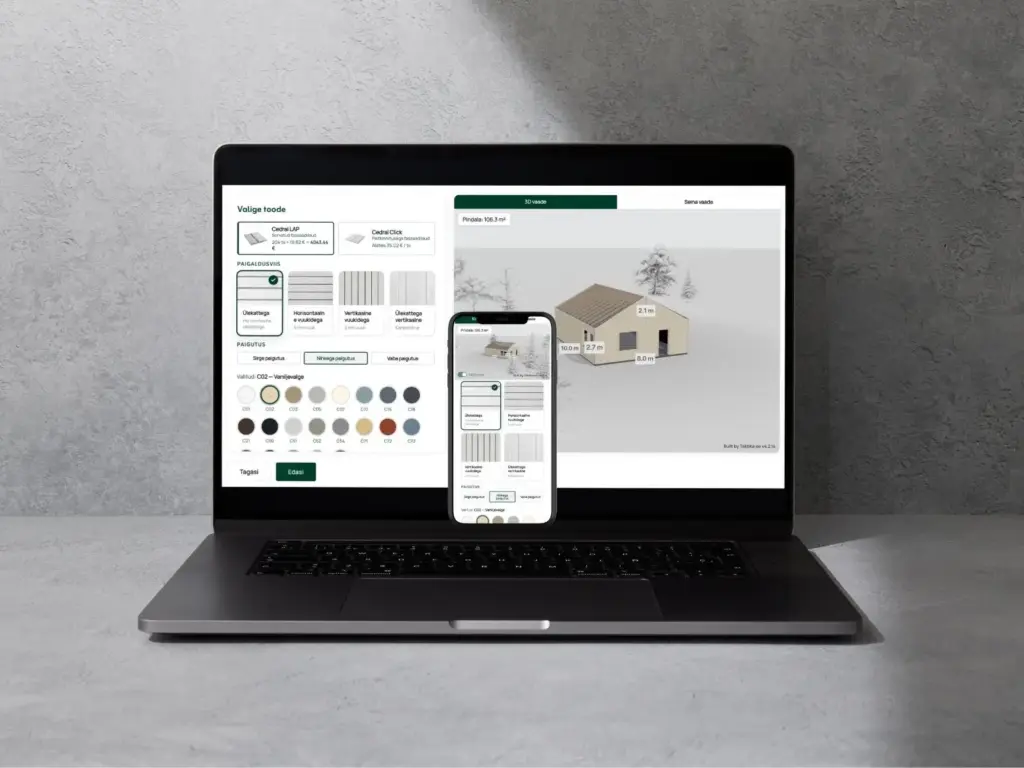
From the client’s point of view the process is five steps. The entire configuration happens at nordhauser.ee/fassaadikalkulaator/, with no registration and no payment.
- House shape and dimensions. The client chooses between four shapes: rectangle, L-shape, T-shape or U-shape. They enter a length and height in metres for each wall. The 3D model is shown immediately on the right, reflecting the entered geometry in real time.
- Windows and doors. Any number of windows and doors can be added to each wall. The dimensions and position of each opening on the wall are adjustable. The 3D model updates with every change, including the gable roof pitch and the related opening constraints.
- Product and colour. The client chooses between two product lines — Cedral LAP (horizontal installation) or Cedral Click (vertical click installation) — and then between 21 colour options. Each choice is shown immediately on the 3D model, so the client sees their future house before ordering.
- Installation method and accessories. Six different installation methods determine how the panels attach to the wall and which aluminium profiles and substructure elements are needed. The system automatically selects the correct profiles for the chosen method. Accessories — corner profiles, flashings, screw sets — are added according to the geometry.
- Summary and quote. The client sees the total quantities: number of boards, metres of profiles, total weight, transport price by destination county (a transport matrix of Estonia’s 17 counties × 5 weight tiers, with a separate fee for the islands when the weight exceeds 6 tonnes). Clicking “Send quote” opens an email form. 30 seconds later the client receives an A4 PDF quote on the company letterhead with a precise specification; Nordhauser’s Merit receives the same quote as a sales document with a quote number from the CP-200000+ series.
The whole process takes on average under 3 minutes, from the client’s first click to the PDF file in their inbox.
Technical decisions that are invisible but matter
The surface of the configurator is simple, but the work that happens hidden from the user determines whether the quote is correct. Four technical choices are worth highlighting separately, because the final price depends on them.
Optimal placement of aluminium profiles into standard lengths. If a house needs twelve corner profiles 2.4 metres long, that does not mean buying twelve profiles. Cedral substructure standard lengths are 3000 mm, 2500 mm and 3600 mm. The configurator fits the required pieces inside the standard lengths so that the longest cuts are matched first and progressively smaller ones into the gaps. Only the boards actually needed go into the quote. On a typical house this saves 2–3 profiles — money that stays with Nordhauser instead of sitting idle in the warehouse.
Separate calculation of opening zones. Specially shaped boards and frames are needed around windows and doors, which a plain façade area calculation does not account for. The configurator isolates the zone surrounding each opening and adds the material belonging to it separately. Anyone who has not installed a façade does not know that this difference is 5–8% of the total material. Without it the quote ends up either under or over — both are bad.
The logic branches of installation methods. LAP installation requires horizontal overlap and a different row geometry than Click’s vertical fastening. Each method uses a different profile set, a different substructure and a different multiplier coefficient. The user sees a single choice, but the system manages six different branch structures. The same 12×8m house may differ by a few boards between LAP and Click — and the quote reflects this exactly.
Gable roof pitch as a constraint on openings. When a wall is triangular (gable shape), a window cannot be at an arbitrary height with an arbitrary width. The configurator calculates, for each horizontal position, the maximum opening size the gable pitch allows. This prevents situations where a quote is issued for a house that actually cannot be built — and that the salesperson would later have to explain to the client.
Every Cedral quote that comes out of the PDF has passed the same four calculation stages that quality control requires of the installation team before work begins.
Integrations: why this is not a toy configurator
The configurator is only the visible part. Behind it are four integrations, each of which replaces a specific piece of manual work.
Merit Aktiva — direct ERP connection. Every quote goes through an HMAC-SHA256 signed API into Nordhauser’s Merit Aktiva accounting system. The quote is created immediately as a sales document, with a number from the CP-200000+ series — not retyped by hand, but generated into the ERP. If some item (panel, profile) is not yet on a Merit product card, it is created automatically. Statistics from the first 11 days: 10 quotes out of 11 (91%) reached Merit on the first API attempt. One went through the retry cycle and arrived a few minutes later. The salesperson does not have to re-enter the quote data into the ERP by hand.
WooCommerce — a single source of truth for the product catalogue. 21 colours × 2 product lines × 9–12 accessories exist as SKUs in Nordhauser’s WooCommerce. The configurator does not copy these prices, it reads them on every usage session. If a price changes in WooCommerce or a new colour option is added, it appears in the configurator immediately. Volume discounts apply automatically. One price-management system, not two.
Three.js — a 3D engine that is also a calculation engine. The 3D image the client sees is not a separate “pretty picture” next to the quote. It is the same geometry that produces the material calculation. When the client changes the width of a window, both the picture and the number change. This ensures the quote and the visual never diverge — the client gets exactly what they saw when ordering.
Dompdf — a PDF that looks like a Merit document. The PDF is generated on the company letterhead, contains the precise BOM (Bill of Materials) and the special transport conditions for the islands when the weight exceeds 6 tonnes. The PDF’s name follows Merit’s numbering, so the client’s and the ERP’s documents are unambiguously linkable.
Each integration replaces one piece of manual work. Four together mean that sales becomes a confirmation layer, not a calculation layer.
The result: what Nordhauser actually got
The configurator went live on 27 March 2026. The first 21 days were an intensive iteration cycle — 40+ versions that refined the user interface, the calculation logic and the ERP integration based on actual usage patterns. As of 17 April 2026, v4.2.10 is running.
Statistics from the first 11 working days (filtered — only real external quotes)
- 11 real quotes from 10 unique clients
- Total pipeline €89,400, individual quotes ranging from €5,691 to €10,704
- 11 quotes out of 11 (100%) reached Merit on the first API attempt
- 9 quotes for the LAP product, 2 for Click (LAP dominates 9:2 even in a small sample)
- 7 different colours chosen out of 21 (the client actually uses the range of options)
- Weekly rhythm: 1 → 7 → 3 quotes, trending upward
Advertising effectiveness. Nordhauser spent an average of €9.86 per real quote generated. That means ~€99 of ad spend produced €89,400 of pipeline within the 11-day window. An important nuance: this is the “amount that went into quotes”, not “contracts signed in total”. Pipeline is not revenue, but it is an input-to-output ratio that the average B2B construction sale will recognise.
What happened with the sales team. With the same number of people, Nordhauser made 11 quotes in 11 days that would have taken roughly 30–40 work hours to prepare by hand. That time is now free for other activities. The most important change is in quality: every quote has passed through the same calculation logic, so “what price did you give me last time” type disputes have disappeared. One calculation engine = one source of truth.
What this means for your company
The Cedral case is specific to a façade, but three signals hold true in every construction and manufacturing sector where the product is configurable.
Signal 1 — preparing a quote takes over 30 minutes and/or requires complicated manual calculations. This means you already have a formal calculation logic — it is just in Excel or in one person’s head. A configurator codifies that logic and hands it to the client without an intermediary.
Signal 2 — your product is combinatorial. Dimensions × colours × materials × extras = every combination is unique. Managing a catalogue by hand grows combinatorially; with a configurator it becomes constant work.
Signal 3 — your competitor responds to an inquiry faster than you. Even if they have a worse price, they win on speed. In construction sales, speed is often more important than price sensitivity, because the client frequently makes the decision based on the first proper quote.
If at least two of the three signals hold, it is worth doing the model maths. We offer a two-week prototype on your product — a week of mapping, a week of a first working version. If it does not create belief that a configurator pays off, there is no next obligation.
FAQ: what entrepreneurs usually ask us
How much does developing a product configurator cost in Estonia?
The first working version of Nordhauser’s Cedral configurator was ready in about 3 weeks, at an average Estonian web-development day rate. The exact sum depends on the size of the product catalogue, the number of integrations and the complexity of the 3D visualisation. The first step is a one- or two-day mapping, after which you get a named budget before construction begins.
How long does a product configurator project take?
The first working version of Cedral was ready in 3 weeks. Then another 3 weeks went into iteration based on actual user feedback. The typical timeframe from first meeting to launch is 4–8 weeks, depending on complexity and the readiness of the product catalogue.
Does a configurator also suit a small web shop running on WooCommerce?
Yes. The Cedral configurator itself runs on WooCommerce. WooCommerce actually simplifies things — the product catalogue, pricing logic and stock are already in place. The configurator is the top layer that reads this data and adds the geometric calculation. It also works on top of Shopify and self-built PHP systems, but WooCommerce is the cheapest starting point.
Will our salespeople be out of work?
No. They stop calculating and start selling. Every quote comes from the configurator already calculated, so the first call to the client is a closing call, not a measurement-gathering call. From the company’s point of view: the same team does more work.
What if the ERP (e.g. Merit, Directo) does not offer an API?
Every modern Estonian ERP offers an API. Merit Aktiva, Directo and SmartAccounts support REST or SOAP interfaces that allow quotes and invoices to be entered. If your ERP is a very old version, we first map out whether an upgrade makes more sense than an external integration.
How do you measure whether the configurator paid off?
Three metrics in the first six months: 1) the average time from inquiry to quote (before vs. after), 2) the number of quotes per salesperson (before vs. after), 3) the ad spend per quote. Nordhauser has all three improved measurably — in your company you can measure the same against your own baseline metrics.
If you have a product that currently lives in Excel — talk to us
The first call is 30 minutes, the second is already a mapping session. You will gain clarity on whether a configurator would work on your product, even if you decide not right now.